CRBN.credit is a carbon market intelligence terminal that brings registry records, compliance prices, regulatory rules and project checks into one place. A large public layer is free with no account, and a terminal of 17 tools covers due diligence, pricing, portfolios, reporting and compliance.
Most people working in carbon markets keep a dozen browser tabs open: several registries, a regulator's website, a price page, a ratings provider, a spreadsheet of retirements, and a folder of PDFs about rules that changed last quarter. CRBN.credit was built as a carbon credit intelligence platform that collapses that into one workspace, with one rule running through all of it: every figure comes from a documented source, and where no source exists, the platform says so. This article walks through what it does, how it works, and, just as important, what it does not do.
- 11,659 carbon credit projects across seven registries, each with a public page and a six-part Credit Passport.
- 400 methodology pages, 261 organisation retirement profiles and 13,065 EU ETS installation pages, all public.
- A dozen free tools and datasets, including a Green Claims Checker for the EU rules that took effect on 27 September 2026, an SBTi Removals Planner and a Compliance Calendar.
- A terminal of 17 tools in four desks, with a Project Dossier, Watchlist alerts and a Retirement Evidence Pack.
- Engines compute every number. AI writes explanations only, and a verifier rejects any figure an engine did not produce.
- The problem: scattered, inconsistent information
- What "all-in-one" means here
- The free public layer
- The Credit Passport
- The terminal: 17 tools in four desks
- The workspace: dossier, watchlist and evidence
- How the numbers are made
- The India CBAM Center
- Who uses it, and for what
- What CRBN.credit does not do
- How it compares in approach
- Getting started
- Frequently asked questions
The problem: scattered, inconsistent information
Carbon market information is public in principle and hard to use in practice.
Project records sit in seven separate registries, each with its own search, field names and export format. Quality decisions come from the ICVCM, eligibility for aviation from ICAO, authorisation under the Paris Agreement from host governments and UN tracking, and compliance data for European industry from the European Commission's Union Registry. Rules change quickly: in the past few weeks alone, the ICVCM approved Verra's latest programme rules and its carbon capture methodology, the EU's ban on offset-based neutrality claims took effect, and India's compliance market moved toward its first trades.
Two problems follow. People spend hours assembling facts that should take minutes, and they rely on figures they cannot trace. In a market where trust is the scarce resource, an untraceable number is a liability.
What "all-in-one" means here
"All-in-one" can mean a platform that does everything badly. CRBN.credit uses it to mean something narrower: the four jobs most carbon market users do every week are in one place, connected to each other, and built on the same data.
- Find and assess a project. Look it up, check its record, quality status, risks and buyers.
- Understand price and market. Compliance prices, market signals, news and the factors behind value.
- Hold, retire and report. Build a portfolio, verify retirements, and prepare disclosures.
- Stay compliant. Know which rules apply, when, and whether a claim holds up.
A project found in the database can be opened in the terminal, audited, rated, added to a watchlist, priced against its market, carried into a portfolio, verified at retirement and cited in a disclosure, without re-entering it anywhere.
The free public layer
A large part of CRBN.credit is free and open with no account. These pages are where most people start.
| Free resource | What it gives you |
|---|---|
| Projects database | 11,659 projects across Verra, Gold Standard, ACR, Climate Action Reserve, ART TREES, Cercarbono and Isometric, each with its record and Credit Passport |
| Methodology pages | 400 methodologies with their projects, issuance, retirements and ICVCM status |
| Retirements by organisation | 261 organisation profiles built from registry retirement records |
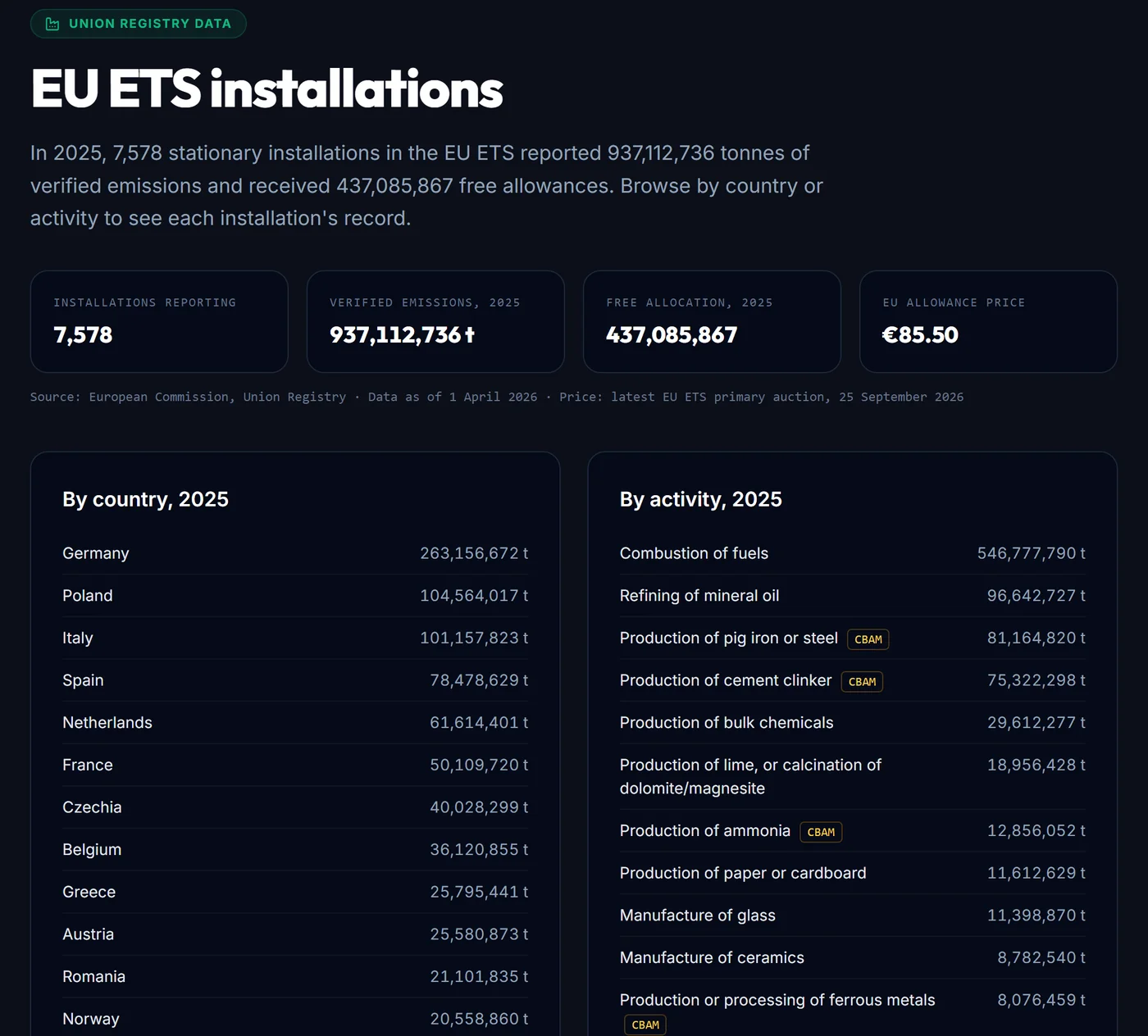
| EU ETS Installation Explorer | 13,065 installations with verified emissions and free allocation by year |
| Carbon prices | The latest EU allowance price and the quarterly CBAM certificate price |
| Compliance tracker | 12 carbon pricing regimes, marked in force, paused, coming or being rescinded |
| Price outlook | Compliance price outlook to 2030, built from each market's realised trend |
| Green Claims Checker | Tests a climate claim against Directive (EU) 2024/825 |
| Removals Planner | The removals SBTi's Net-Zero Standard V2.0 requires each year from 2035 |
| Compliance Calendar | CBAM, EU ETS, ETS2, CORSIA, SBTi and green claims dates, with a subscribable feed |
| Footprint calculator | Estimates from published government conversion factors |
| India CBAM Center | 14 pages of free CBAM preparation tools for Indian exporters |
The projects database, methodology pages and organisation profiles connect to each other. A project page links to its methodology, its host country and the organisations recorded as its buyers; an organisation profile, among the retirements by organisation, links back to every project it retired from. The EU ETS Installation Explorer works the same way across countries and sectors, and shows the CBAM phase-out of free allocation where it applies, without ever projecting an installation's future cost.
The Credit Passport
Every project page carries a Credit Passport: six checks on one project from different authorities, each with its result, its general source and its date.
- ICVCM quality status: the current ICVCM decision on the project's methodology. A CCP label requires both an approved programme and an approved methodology, and the page says so.
- CORSIA screen: checks against ICAO's published criteria for the first and second phases. It never declares a credit eligible; it shows which checks pass and which cannot be confirmed from published data.
- Host country Article 6 position: the country's bilateral agreements, authority status and authorised activities, as context rather than project-level authorisation.
- Hazard exposure: for nature-based projects, recent fire detections and published hazard levels.
- Recorded buyers: organisations named as beneficiaries in registry retirement records, linked to their profiles.
- Declared SDGs: the goals a project declared to its registry, without invented impact numbers.
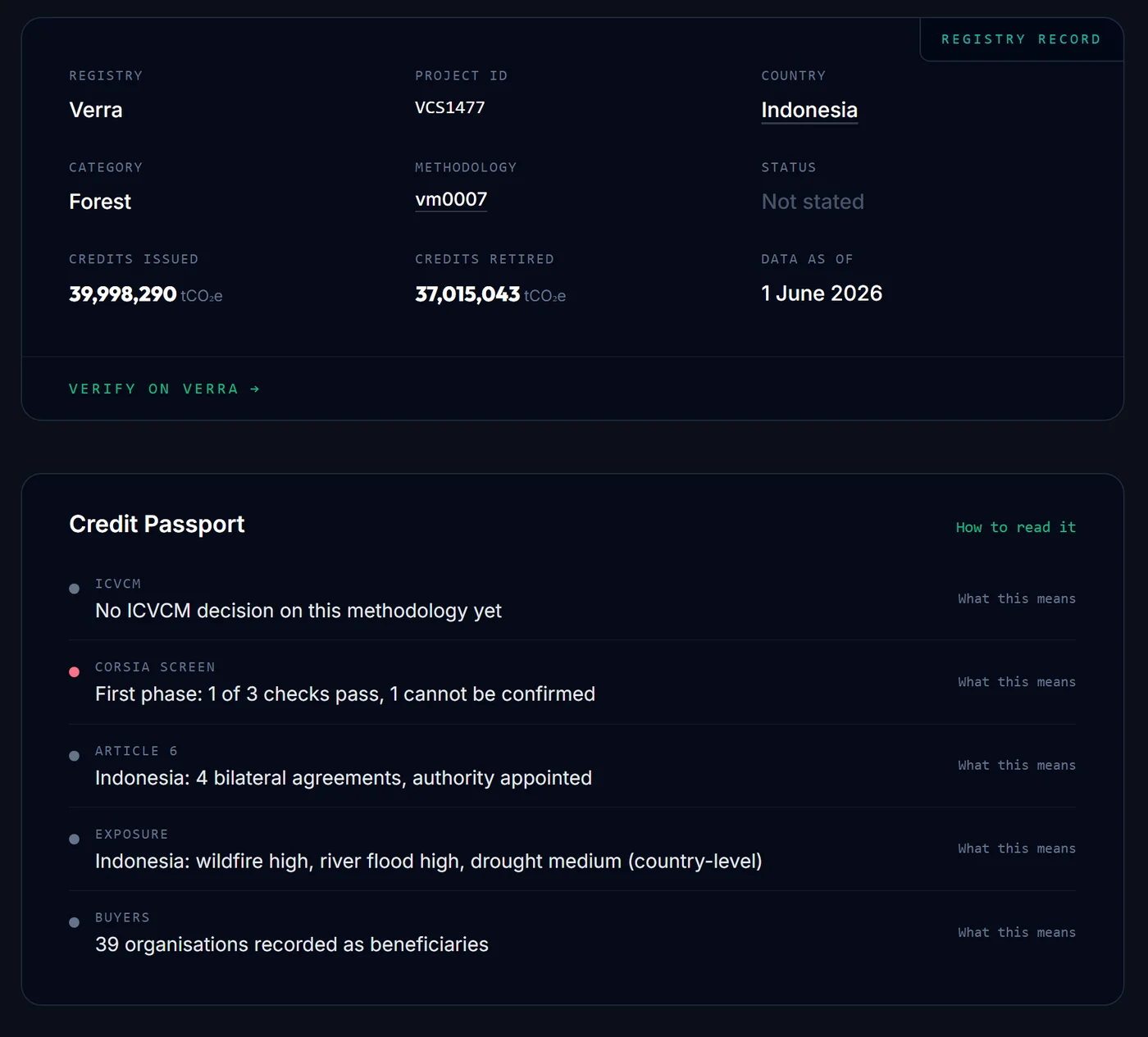
The page that explains how each Credit Passport check works sets out exactly what each layer does and does not mean.
The terminal: 17 tools in four desks
Behind sign-in, the terminal groups 17 tools into desks that match the four jobs. Eleven are metered, using one assessment per run; six are free on every plan.
Buyer Desk. The Project Auditor gathers every published record for a project into an evidence-linked report. The Rating Analyzer builds the CRBN Quality Index across twelve adjustable dimensions, each showing its raw value, weight and source. Registry Lookup reconciles a project's full issued, retired and remaining ledger. The Methodology Lab compares methodologies by observed outcomes. Portfolio Architect builds a screened portfolio from real projects. The Retirement Ledger verifies each claimed retirement against what the project actually issued.
Market Desk. The Benchmark Tracker puts compliance markets on one board in one currency. Price Forecast builds scenario ranges from measured trend and volatility. The Carbon Valuation Desk states a price where one is published and explains what drives value where none is. The Genius Screener screens the database with live market signals. The News Screener shows real, dated, linked coverage from 13 sources.
Reporting Desk. The Scope 3 Identifier builds a screening inventory from published emission factor tables. The Net Zero Generator models reduction pathways using SBTi's method. SDG Impact reports only what a project declared to its registry. Climate Disclosure drafts against IFRS S2, ESRS E1 or TCFD, with computed figures and labelled templates for facts no dataset holds.
Compliance Desk. The Compliance Navigator decides which regulations apply and when, as a threshold test against dated rules. The Risk Heatmap scores physical and governance risk by location. The free Green Claims Checker, Removals Planner, Compliance Calendar and India CBAM Center sit here too.
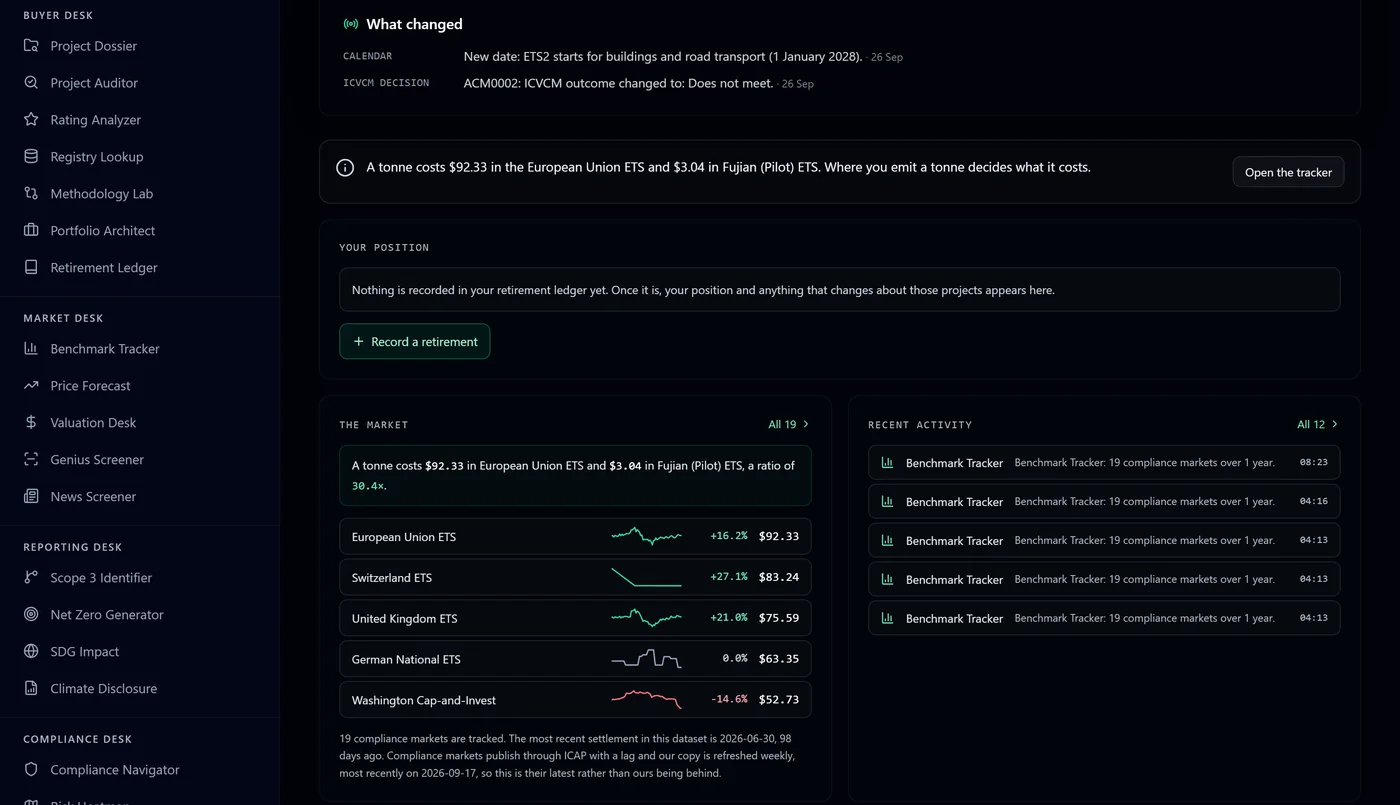
You can see every tool working before paying: the recorded walkthroughs of all 17 tools show each one running.
The workspace: dossier, watchlist and evidence
Around the tools sits a workspace, free on every plan.
- Project Dossier: one project, every view of it, with the audit, quality, registry, methodology and risk tools in tabs. Opening it costs nothing; a metered tool runs only when you press its button.
- Watchlist: follow up to 200 projects, methodologies, countries, organisations, installations and calendar topics. Alerts arrive when a watched item changes, calendar reminders come 30 and 7 days before each date, and email digests can be immediate, daily or weekly.
- Retirement Evidence Pack: turns retirement records into an auditor-ready file, with each retirement checked against the registry and the facts behind each project.
- Knowledge Hub: one search across terms, methodologies, regulations, standards, registries, countries, projects and tools, each answer with its source.
- Activity and history: every report you ran, with the figures behind it, and every free tool you used, ready to reopen or rerun.
How the numbers are made
The platform follows one architecture everywhere, because in carbon markets an invented number does real damage.
- An engine computes every figure from sourced data, with no model involved in the calculation.
- A narrative layer writes prose about figures already computed. It adds none of its own.
- A verifier rejects any output containing a figure the engine did not produce.
- Failures are named, never hidden behind a plausible default.
That architecture leads to deliberate refusals. Voluntary market transaction prices are held by commercial reporting services and are not freely verifiable, so the platform does not publish a blended voluntary price; it explains what drives value instead. SDG Impact will not invent jobs, hectares or households a project never reported. No tool issues buy, hold or sell calls. Each refusal is a design decision, documented on the data methodology page.
The India CBAM Center
The India CBAM Center is the platform's most focused section: 14 free pages for Indian exporters of steel, aluminium, cement and fertiliser facing the EU's Carbon Border Adjustment Mechanism.
It is built on the definitive-period rules in force since 1 January 2026. The calculator implements the embedded emissions equations in Annex IV of Implementing Regulation (EU) 2025/2547, including precursors and the correct functional unit for each product, such as tonnes of clinker for cement and nitrogen content for some fertilisers. It compares the result with the Commission's published default values, drawn from the Commission's own workbook of 283 goods and 122 countries, plus the applicable mark-up. Around it sit an evidence pack builder, a readiness check, sector document checklists, sector pages listing default values by CN code, a page on what India's CCTS and PAT reporting does and does not cover for CBAM, and a page tracking how many CBAM verifiers are accredited.
The Center prepares evidence. It does not verify emissions or file declarations, and it says so on every result.
Who uses it, and for what
- Carbon credit buyers and procurement teams: shortlist projects, check quality and risk, verify retirements and keep an evidence trail.
- Sustainability and reporting teams: check claims against the EU rules, plan SBTi removal requirements, and draft disclosures with traceable figures.
- Analysts, traders and funds: follow compliance prices, market signals, ICVCM decisions and news in one place, with alerts on what changes.
- Project developers: see how their methodology performs across the market and how their projects appear to buyers.
- Consultants and advisers: run the same checks across many clients with consistent, sourced outputs.
- Exporters facing CBAM: calculate embedded emissions, see the cost of default values, and prepare for verification.
What CRBN.credit does not do
A platform is easier to trust when it is clear about its limits.
- It does not broker, trade or sell carbon credits. It provides data, research and analysis.
- It is not an independent ratings agency. Firms such as Sylvera, BeZero Carbon and Calyx Global publish independent project ratings. The CRBN Quality Index is a transparent, adjustable index whose formula is published in the tool, not a rating.
- It does not publish voluntary market transaction prices, for the reason above.
- It does not give legal or financial advice. Tools that interpret regulation say so.
- Its registry records follow the compilation's release dates. The registry compilation behind the projects database is released irregularly and is checked daily for new releases; every page shows the date its records reflect.
- It has no public API yet. Every tool exports its own figures.
How it compares in approach
Different tools solve different problems. The comparison below is about approach, not a ranking.
| Approach | Typical strength | Typical limitation for day-to-day research |
|---|---|---|
| Registries themselves | The official record for their own projects | Seven separate systems, different formats, no cross-registry view |
| Ratings agencies | Deep, independent project ratings | Ratings sit behind subscriptions and cover rated projects |
| Enterprise data terminals | Broad institutional coverage | Pricing negotiated through sales, often beyond small teams |
| CRBN.credit | Cross-registry records, regulatory tools and sourced analysis in one terminal, with a large free layer and published plans | Not a ratings agency, and no voluntary transaction price feed |
Many teams use more than one. A buyer might use CRBN.credit to shortlist and verify, and a ratings agency for a final independent opinion on the projects that matter most. The platform comparison sets out how CRBN.credit differs from specific alternatives.
Getting started
- Start with the free layer. Look up a project you know in the projects database and read its Credit Passport.
- Watch the tools run. The recorded walkthroughs show every terminal tool on real data.
- Try the terminal. A 14-day free trial includes every tool and the whole database, with 25 assessments for the metered tools. A card is taken at sign-up, and nothing is charged until day 15.
- Choose a plan if it fits. The published plans are listed openly, with no sales call needed.
Three plans, printed on the page.
No quote, no sales call and no minimum term. Every plan carries the full database and every tool.
Frequently Asked Questions
What is a carbon credit intelligence platform?
A tool that brings together the information needed to research, buy, hold and report on carbon credits: registry records, quality decisions, prices, regulations and risk. CRBN.credit combines these in one terminal with a large free public layer.
Is CRBN.credit free?
A large part is free with no account: the projects database with Credit Passports, methodology pages, organisation profiles, the EU ETS Installation Explorer, carbon prices, the Green Claims Checker, the Removals Planner, the Compliance Calendar and the India CBAM Center. The full terminal has a 14-day free trial and published plans.
Where does CRBN.credit's data come from?
From carbon registries, ICVCM decisions, ICAO criteria, UN Article 6 tracking, the European Commission and other official and published sources. The data methodology page documents them.
Does CRBN.credit rate carbon credits?
No. It is not a ratings agency. The CRBN Quality Index is a transparent index with a published formula and adjustable weights, and the Credit Passport reports facts from named authorities.
Can I buy carbon credits on CRBN.credit?
No. CRBN.credit provides data and analysis. It does not broker, trade or sell credits.
Does CRBN.credit use AI?
Yes, to write explanations and classify inputs into closed lists. AI never produces a figure that reaches the screen: engines compute every number, and a verifier rejects any figure an engine did not produce.
Who is CRBN.credit for?
Carbon credit buyers, sustainability and reporting teams, analysts and funds, project developers, consultants, and exporters preparing for CBAM.
Sources
This article describes CRBN.credit itself. The data methodology page documents every source the platform uses.
A note on this article. Figures describe CRBN.credit as of 5 October 2026 and change as data is added. CRBN.credit provides data and research tools. It does not execute trades, sell carbon credits, verify emissions, or provide financial or legal advice.