A carbon credit buffer pool is a shared reserve of credits that forestry and other land projects set aside to cover carbon that is later lost. Registry records show about 159 million credits paid into buffers, 14.3 million drawn to cover reversals and 6.6 million released back to projects, leaving about 138.6 million.
Buffers are the reason a forest credit can promise to stand for a tonne kept out of the atmosphere even though forests burn. They are also one of the least examined parts of the market: most buyers never look at the pool behind the credits they hold. This guide explains how buffer pools work, what each registry holds according to project records, which projects have reversed, and how to test how long a pool would last.
- Projects at risk of reversal pay a share of their credits into a pooled buffer at issuance. Verra's contributing projects have paid in 14.3% of the credits issued to them; ACR's and the Climate Action Reserve's about 23%.
- Project-level records show Verra's pool at about 76.3 million credits, ACR's at 34.4 million and the Climate Action Reserve's at 22.3 million.
- 46 projects have a reversal on record. The two largest, an improved forest management project in Washington State and the Kariba REDD+ project in Zimbabwe, each had more than 5 million credits of reversal covered by a buffer.
- Reversals not covered by a buffer, which owners must compensate themselves, total 4.4 million credits, all on ACR and Climate Action Reserve projects.
- At the reversal rates recorded so far none of the three large pools runs out within 30 years. At a sustained 1% a year, Verra's recorded balance would be used up by 2041.
What a buffer pool is
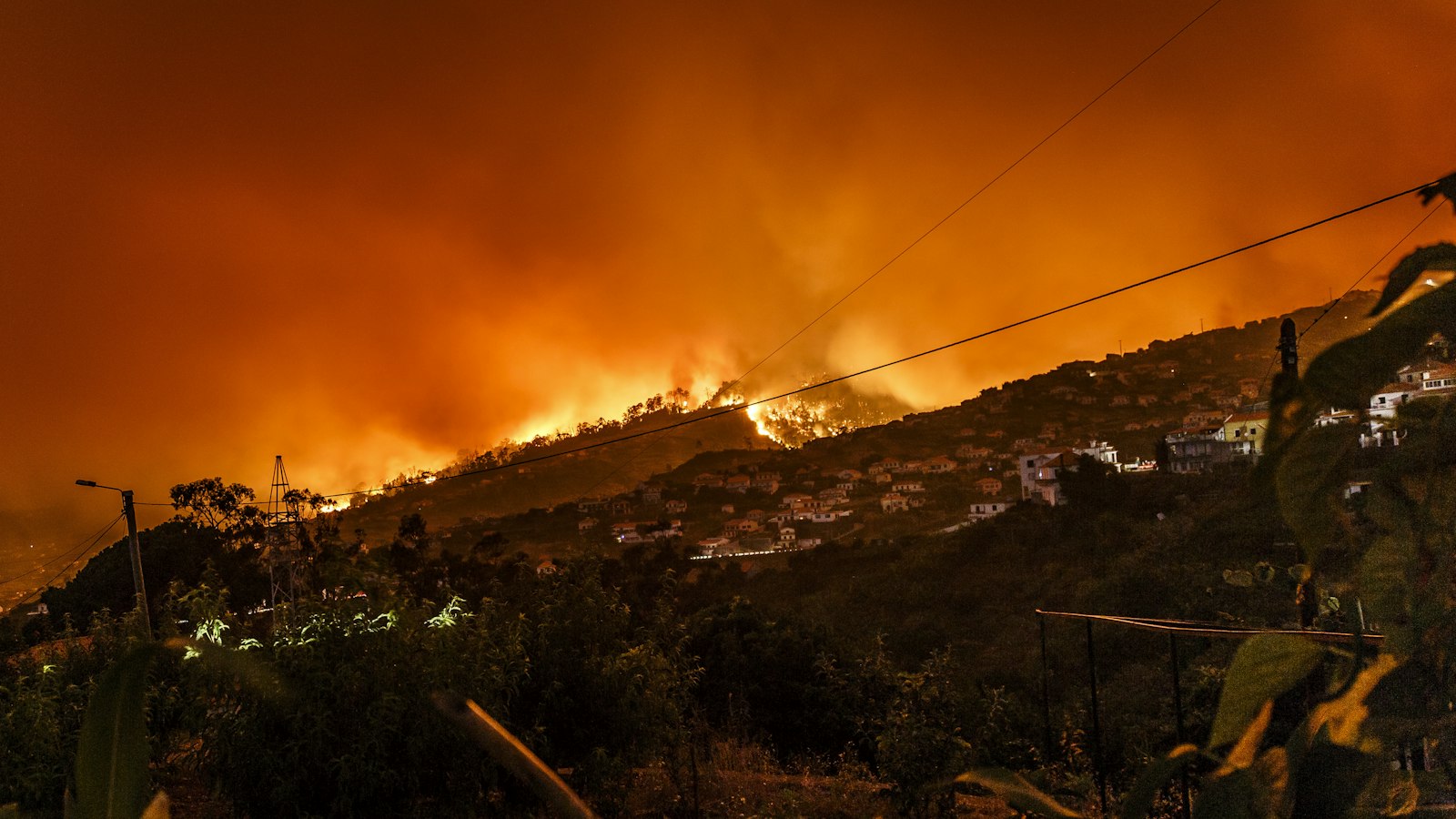
A carbon credit from a forest or soil project represents carbon that has been kept in, or taken into, the land. Unlike a tonne of methane that was destroyed, that carbon can come back out. A fire, a beetle outbreak, a storm or a decision to log can release it years after the credit was sold and used.
Registries that issue credits for stored carbon deal with this risk collectively. Each project that could reverse deposits a share of its credits into a pooled account instead of selling them. When a project loses carbon, the registry cancels credits from that account to match the loss. The buyer's credit is not touched: the pool absorbs the loss on behalf of everyone who holds credits from projects in it.
That makes a buffer pool a form of insurance, with two differences. It is paid for in credits rather than money, and it is shared across projects of very different risk. Its strength depends on whether deposits keep pace with losses across the whole pool over decades, which is why the numbers matter.
How much each project pays in
The share a project deposits depends on its assessed risk of reversal. Verra assesses it with its AFOLU non-permanence risk tool, which scores internal risks such as project management and financial viability, external risks such as land tenure and community relations, and natural risks such as fire and drought. ACR and the Climate Action Reserve use their own assessments, and riskier projects pay a larger share.
Across the projects that contribute, the shares recorded so far are:
| Registry | Contributing projects | Credits issued to them | Deposited | Share deposited |
|---|---|---|---|---|
| Verra | 302 | 617.6 million | 88.6 million | 14.3% |
| ACR | 205 | 181.6 million | 41.2 million | 22.7% |
| Climate Action Reserve | 426 | 107.0 million | 24.1 million | 22.6% |
| ART TREES | 2 | 59.5 million | 3.6 million | 6.1% |
| Gold Standard | 53 | 51.7 million | 1.9 million | 3.7% |
More than 98% of the deposits in each of the three large pools come from forestry and land use projects. Gold Standard's smaller pool also holds deposits from renewable energy and waste projects, and Isometric, a registry for engineered removals, holds a little over 3,000 credits from projects whose storage could in principle leak.
What each registry holds
Adding up every project's deposits, the reversals the buffer covered and the credits released back gives the balance implied by the records:

| Registry | Deposited | Reversals covered | Released | Recorded balance |
|---|---|---|---|---|
| Verra | 88,578,205 | 5,684,505 | 6,591,601 | 76,302,099 |
| ACR | 41,174,408 | 6,813,968 | 0 | 34,360,440 |
| Climate Action Reserve | 24,147,080 | 1,801,593 | 5,002 | 22,340,485 |
| ART TREES | 3,644,366 | 0 | 0 | 3,644,366 |
| Gold Standard | 1,907,611 | 0 | 0 | 1,907,611 |
Two cautions. These are sums of project-level records, so a registry's own pool account can differ where it records adjustments that are not attached to a single project. And the records come from a compilation released every few months, so the latest reversals may not yet appear. The carbon credit buffer pools page shows the same figures with their data date and updates when the compilation does.
Covered and uncovered reversals
Registries distinguish two kinds of loss.
Covered reversals are losses the project could not reasonably prevent, such as wildfire, disease or a storm. The registry cancels credits from the pool to match them. These account for 14.3 million credits across the records: 5.7 million on Verra, 6.8 million on ACR and 1.8 million on the Climate Action Reserve.
Uncovered reversals are losses the buffer did not pay for. Registries generally treat intentional reversals, such as harvesting beyond what a project committed to, as the owner's responsibility: the owner must retire other credits to compensate. They total 4.4 million credits, 1.3 million on ACR and 3.1 million on the Climate Action Reserve. Verra's records show none.
The split matters to a buyer for a simple reason. A covered reversal draws down the shared pool, which every holder of credits in it relies on. An uncovered reversal leaves the pool intact but depends on the owner having the credits, or the money to buy them, when the time comes.
The largest recorded reversals
46 projects have a reversal on record. The largest by volume:
| Project | Registry | Location | Covered | Not covered |
|---|---|---|---|---|
| Finite Carbon, Colville IFM | ACR | United States | 5,532,868 | 0 |
| Kariba REDD+ Project | Verra | Zimbabwe | 5,049,473 | 0 |
| Green Diamond Resource Company, Klamath East IFM | ACR | United States | 1,145,363 | 0 |
| Trinity Timberlands, University Hill IFM | Climate Action Reserve | United States | 847,895 | 0 |
| Willits Woods IFM | Climate Action Reserve | United States | 119,018 | 681,970 |
| Sacramento Canyon | Climate Action Reserve | United States | 0 | 662,284 |
Two features stand out. Reversals are concentrated: the two largest projects alone account for about three quarters of all covered reversals on record. And 35 of the 46 are improved forest management projects, 38 of them in the United States, where fire risk is rising and where registries have published reversal data for longest. A single large event can move a pool more than years of small ones.
Releases
Buffer credits do not always stay in the pool. Some registries return part of a project's buffer contribution over time, for example when a later risk assessment rates the project as less risky, or as the project demonstrates that its carbon has been maintained. Verra's records show 6.6 million credits released back to projects, more than the 5.7 million it has cancelled to cover reversals.
Releases are not losses, but they reduce the pool's balance just the same. When judging a pool, look at what has gone out for any reason, not only at reversals.
How long would a pool last?
There is no reliable way to predict how many forests will burn, so the useful question is conditional: at a given rate of loss, how long would the recorded balance last? CRBN.credit's buffer pool scenario answers it with plain arithmetic. Each year, credits at risk grow by new issuance, the pool gains its share of that issuance, and a reversal rate you choose is drawn from it.
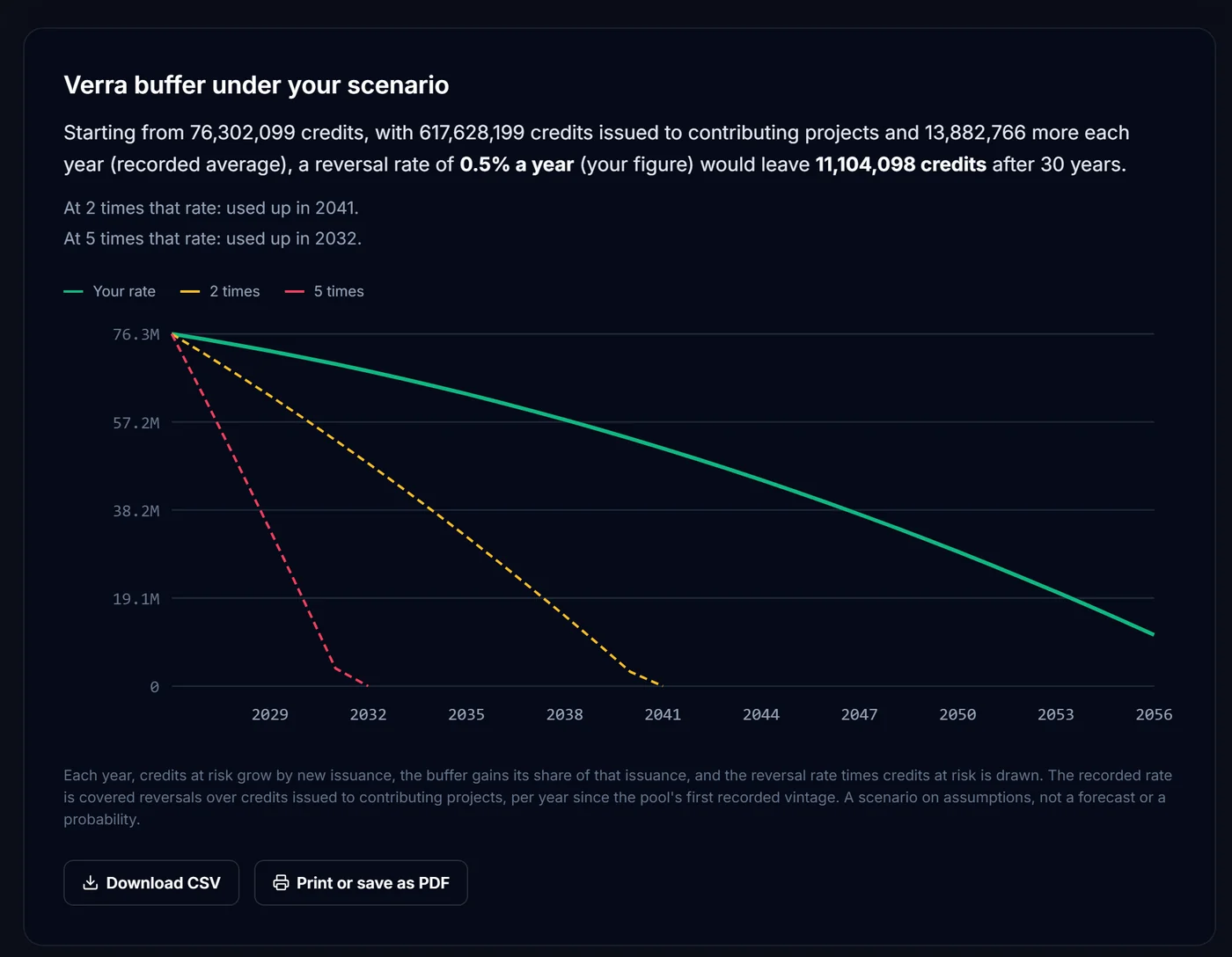
Run with each pool's own recorded figures, the results look like this:
| Pool | At the rate recorded so far | At 0.5% a year | At 1% a year |
|---|---|---|---|
| Verra | Lasts beyond 30 years, even at 5 times the rate | Lasts 30 years; at 2 times, used up in 2041 | Used up in 2041 |
| ACR | Lasts 30 years; at 5 times, used up in 2055 | Lasts 30 years; at 5 times, used up in 2037 | Lasts 30 years; at 2 times, used up in 2040 |
| Climate Action Reserve | Lasts beyond 30 years, even at 5 times the rate | Lasts 30 years; at 5 times, used up in 2037 | Lasts 30 years; at 2 times, used up in 2040 |
The recorded rates are low: covered reversals have run at about 0.04% of contributing issuance a year for Verra, 0.07% for the Climate Action Reserve and 0.22% for ACR. Whether they stay low depends on fire and climate in the places these projects sit. Published research on California's compliance forest offsets has argued that the buffer there was sized too small for the wildfire losses it now faces, which is a reason to test pools at rates well above the past rather than assume history repeats.
The figures are a scenario on assumptions, not a forecast or a probability. Their value is in showing how sensitive a pool is: a rate that sounds small, sustained for a decade, can empty a pool that looks large today.
What it means for buyers
- The pool is part of what you are buying. A forest credit's permanence rests on its registry's pool. Two credits from similar projects on different registries carry different protection.
- Concentration is the risk to watch. Because a few large events dominate the record, a single bad fire season in one region can matter more than the long-run average.
- Uncovered reversals depend on the owner. Where a reversal is the owner's responsibility, the protection is only as good as the owner's ability to compensate.
- Permanence and delivery are separate risks. A buffer protects credits that already exist. It does nothing for credits a project was expected to issue and never did, which is the risk the offtake calculator measures for forward contracts.
- Check the project, not only the pool. The hazard exposure on each project's Credit Passport shows the fire and other natural risks in its area.
Check the buffer behind the credits you hold.
Buffer Exposure in the CRBN.credit terminal reads your Retirement Ledger, or a list of project IDs, and shows each project's deposits and any reversal on record, beside the pool that stands behind it.
How to check the credits you hold
- Find the project's registry and type. Only projects that could reverse contribute to a buffer. A renewable energy credit has no buffer behind it because it has nothing to reverse.
- Read its buffer contributions. The project's record in the projects database links to its registry entry, which lists buffer deposits by vintage.
- Look for reversals on record. A covered reversal means the pool has already paid out for this project; an uncovered one means the owner had to compensate.
- Look at the pool as a whole. Its balance, what has gone out and how concentrated its contributors are.
- Test it. Run the pool at a rate you consider plausible, and at a multiple of it, before relying on it for a long-dated claim.
Related reading. Our guide to what it means to retire a carbon credit explains what a retirement does and does not prove, and the methodology pages show each forest methodology's projects and ICVCM status.
CRBN.credit provides data and research on carbon markets. It does not broker, sell or execute trades in carbon credits.
Frequently Asked Questions
What is a carbon credit buffer pool?
A shared reserve of credits that projects at risk of losing stored carbon, mostly forestry and land use, set aside when their credits are issued. If carbon is later lost, credits are cancelled from the reserve to make good the loss, so credits that buyers already hold stay whole.
How much is held in buffer pools?
Project-level registry records show about 159 million credits deposited across the registries covered, 14.3 million cancelled to cover reversals and 6.6 million released back to projects. Verra holds the largest pool, about 76.3 million credits by these records.
What is the difference between a covered and an uncovered reversal?
A covered reversal is a loss compensated from the buffer, typically an unavoidable one such as a wildfire. An uncovered reversal is one the buffer did not pay for, usually an intentional loss such as harvesting beyond what the project allowed, which the project owner must compensate with other credits.
Can a buffer pool run out?
Yes, if reversals grow faster than deposits for long enough. Published research has argued that California's compliance forest offset buffer was sized too small for the wildfire losses it now faces. The buffer pool scenario on CRBN.credit shows how long a pool would last at a reversal rate you choose.
Does a buffer pool protect a credit I have already retired?
Yes. A retired credit stays retired. When the project behind it reverses, the registry cancels buffer credits rather than reaching back to the credit you used, as long as the buffer covers that kind of reversal.
How do I check a project's buffer record?
Look up the project and read its issuance and buffer contributions in the registry, or use Buffer Exposure in the CRBN.credit terminal, which reads your Retirement Ledger and shows each project's deposits and any reversal on record.
Sources
- Berkeley Carbon Trading Project, Voluntary Registry Offsets Database, release v2026-06 (buffer deposits, reversals and releases by project)
- Verra, AFOLU Non-Permanence Risk Tool
- ACR, Buffer Pool Terms and Conditions
- Climate Action Reserve, Forest Protocol, Buffer Pool provisions
- Badgley et al., "California's forest carbon offsets buffer pool is severely undercapitalized", Frontiers in Forests and Global Change (2022)
A note on this article. Figures are summed from project-level records in the Berkeley Voluntary Registry Offsets Database release of June 2026, as read on 10 October 2026. A registry's own pool account can differ. The scenarios are arithmetic on stated assumptions, not forecasts. General information, not investment advice.