Host country risk is the chance that the government where a carbon project sits changes the rules under it. Since 2021, governments in 14 host countries have paused projects, claimed a share of revenue, required authorisation, set benefit-sharing terms or reopened trade, and the countries involved account for 39% of all credits issued by the projects in our database.
For most of the voluntary market's history, host governments had little say in what happened to credits generated on their land. That has changed quickly. This article sets out what host governments have actually done, why it matters to anyone buying or holding credits, and how to check the countries behind your own portfolio, using the record CRBN.credit keeps of each action with its date and sources.
- 23 government actions on carbon credits are recorded in 14 countries since 2021. 7 tightened the rules, 4 opened them up and 12 set rules out.
- Three pauses stand out: Indonesia's halt to cross-border sales from 2021 to 2025, Papua New Guinea's moratorium on voluntary REDD+ projects from 2022 to 2025, and Honduras's 2022 pause on voluntary forest credit sales.
- Revenue and benefit sharing is the fastest-moving area. Kenya requires land-based projects to pay communities at least 40% of earnings; Zimbabwe announced a 50% state share in 2023 and set lower terms in 2025.
- 112 of 150 host countries have appointed an Article 6.4 authority, the body that can authorise credits under the Paris Agreement Crediting Mechanism.
- Countries with recorded actions host projects that account for 39% of credits issued in the database; countries that tightened the rules, 24.5%.
Why host countries now matter
The Paris Agreement gave every country its own emissions target. A reduction generated in a country and sold abroad is one the country could otherwise count toward that target. Governments that once saw carbon projects as private arrangements between developers and buyers now see them as a national asset, and a source of revenue.
Three things followed. Countries built rules for authorising credits to leave, so that they do not count the same tonne twice. Several paused new projects while those rules were written, often after controversies over particular deals. And many began asking for a share of what projects earn, for the state, for communities, or both.
None of that is unreasonable, and much of it makes credits more credible. But each change can affect a credit after it has been contracted: a pause can delay issuance, a new levy can change a project's economics, and an authorisation requirement can decide whether a credit can be used for the claim a buyer intended.
What governments have done
The host country policy tracker records each action with its date, what it did and the sources it rests on. Classified by effect, the record so far looks like this:

Actions are labelled by what they did on their face. Tightening means restricting projects or exports or taking a share of revenue. Opening means lifting a restriction or authorising credits. Setting rules out means a framework that does neither, such as a registry or an authorisation procedure.
Pauses and reopenings
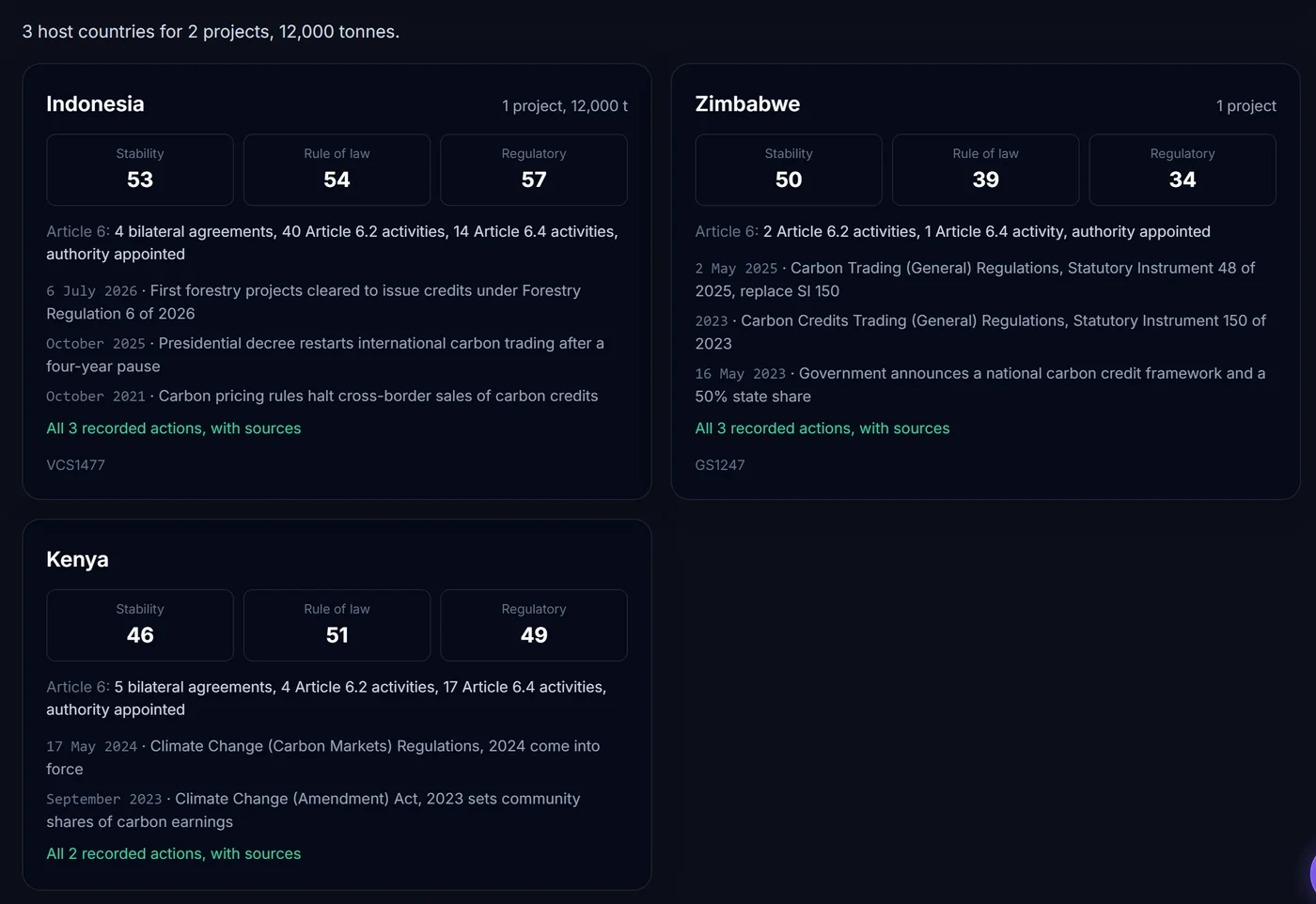
Indonesia. Presidential Regulation 98 of 2021 on the economic value of carbon focused on a domestic compliance market, and reporting at the time said it effectively halted cross-border sales of credits, including from large forest projects. A presidential decree in October 2025 restarted international trading under national standards or UNFCCC and other international standards, with a real-time registry to prevent double counting. In July 2026 the forestry ministry cleared the first four forest projects to issue credits under its new forestry regulation.
Papua New Guinea. In March 2022 the environment minister banned new and proposed REDD+ projects for the voluntary market with immediate effect, while safeguards were written under the amended Climate Change (Management) Act. The moratorium was lifted in April 2025, with the minister saying regulations, guidelines and safeguards were in place.
Honduras. In June 2022 the environment ministry and forest agency paused sales of forest credits that did not conform to the UNFCCC REDD+ framework. A special law on forest carbon transactions followed in October 2023, creating a national commission and a registry.
The pattern across all three is similar: a pause after concerns about particular deals, a period of rule writing, and a reopening under a national framework. For a buyer, the risk is the gap in the middle. Credits contracted before a pause can be delayed for years.
Revenue shares and benefit sharing
Zimbabwe announced a national framework in May 2023 setting the state's share at 50% of revenue from carbon projects, and its information minister said earlier agreements with international organisations were void. Statutory Instrument 48 of 2025 later replaced the 2023 regulations and established a Carbon Markets Authority; reports describe the state's share under it as 30%, though sources differ on the exact terms.
Kenya's Climate Change (Amendment) Act of 2023 requires land-based projects to pay local communities at least 40% of the previous year's aggregate earnings, and other projects at least 25%, under a Community Development Agreement. Its Carbon Markets Regulations of 2024 set out how the designated authority approves projects and applies corresponding adjustments.
Tanzania's 2022 regulations formalised the government's role in carbon projects and provided for distributing revenue from credit sales, and were amended in 2023. Zambia's 2026 regulations require community development and benefit-sharing agreements. Ghana charges application, administrative, corresponding adjustment and listing fees on Article 6.2 transactions.
Benefit sharing is not a risk in itself; communities near projects have a strong claim to their proceeds. The risk for a buyer is change: a project priced on one set of terms that must meet another can struggle to deliver what it promised.
Article 6 authorisation
Under Article 6 of the Paris Agreement, a host country can authorise credits for use toward another country's target or for other international purposes, and apply a corresponding adjustment so it does not count the reduction itself. CORSIA requires authorised units in its first phase. Guyana became the first country to supply them in February 2024, when ART issued 7.14 million jurisdictional forest credits with a corresponding adjustment reported to the UNFCCC.
Authorisation needs institutions. Of the 150 countries that host projects in our database, 112 have appointed an authority for the Paris Agreement Crediting Mechanism under Article 6.4, and 56 have signed at least one bilateral agreement under Article 6.2, according to UNEP Copenhagen Climate Centre's Article 6 Pipeline. Countries also choose which activities they will authorise at all: India published a list of eligible activities in February 2023 and in September 2025 removed clean cookstoves from it.
For a credit that will only ever be used for a voluntary contribution claim, authorisation may not be needed. For one meant to support a CORSIA obligation or, in time, a neutralisation claim under the SBTi standard, it can decide whether the credit is usable at all. Our guide to Article 6 of the Paris Agreement covers the mechanics.
Governance scores as context
Beside each country, the tracker shows three of the World Bank's Worldwide Governance Indicators on a scale of 0 to 100, where higher is stronger: political stability and absence of violence, rule of law, and regulatory quality. They describe a country as a whole and move slowly. They are context for a project, not a forecast of what a government will do: several countries with middling scores have built clear carbon market rules, and a high score did not stop others from changing course.
That is why the tracker shows no combined risk score. No dataset measures the chance that a government revokes an authorisation or claims a share of revenue, and folding governance scores, Article 6 counts and past actions into one number would suggest a precision that does not exist.
How much of the market is exposed
Measured by credits issued by the projects in our database, the 14 countries with a recorded action account for 39% of the market. India alone, with 1,907 projects and 411 million credits issued, has two recorded actions on which activities it will authorise for export. Projects in Brazil have issued 149 million credits, and those in Peru, Indonesia and Kenya between 85 million and 99 million each.
Countries that tightened the rules at some point account for 24.5% of credits issued. The 33 host countries without a recorded Article 6.4 authority account for 23.4%, almost all of it the United States, whose credits are mostly used domestically.
What it means for buyers
- Know the host country before you sign. A forward contract runs for years. A pause or new levy during that time can change what arrives, which the offtake calculator lets you price as a lower delivery rate.
- Ask whether the credit needs authorisation. For CORSIA and for some corporate claims it does. The Credit Passport shows each project's host country Article 6 position.
- Read benefit-sharing terms into the project's economics. A project that pays communities 40% of earnings needs a price that supports it.
- Watch for change, not just the current rule. Several countries in the record changed their rules more than once in three years.
- Remember the opening moves too. Reopenings and authorisations can make credits from a country more valuable, not less.
Group your credits by host country.
Host Country Exposure in the CRBN.credit terminal reads your Retirement Ledger, or a list of project IDs, and puts each country's recorded actions, Article 6 position and governance scores beside the credits you hold, with a CSV.
How to check your credits
- List the projects behind your credits. Use their registry IDs, as they appear on the project page.
- Check each host country. Type the IDs or country names into the tracker's check, up to 25 at a time.
- Read what applies. Recorded actions, the Article 6 position and anything flagged, such as a recent tightening or no Article 6.4 authority.
- Go to the source. Every action lists the notices and reporting it rests on. Read them before relying on a figure.
- Keep watching. The tracker lists the latest reporting on host-country carbon policy from publishers' feeds, and each country's page in the country hubs shows its record.
CRBN.credit provides data and research on carbon markets. It does not broker, sell or execute trades in carbon credits.
Frequently Asked Questions
What is host country risk for carbon credits?
The chance that the government of the country where a project sits changes the rules under it, by pausing projects, claiming a share of revenue, requiring authorisation before credits leave the country or setting benefit-sharing terms. It can delay issuance, reduce what a developer earns, or stop credits being exported.
Which countries have paused carbon credit projects?
Among the actions recorded on CRBN.credit, Papua New Guinea paused new voluntary REDD+ projects from March 2022 until April 2025, Honduras paused sales of voluntary-market forest credits in June 2022, and Indonesia halted cross-border sales from 2021 until a decree reopened them in October 2025.
Do governments take a share of carbon credit revenue?
Some do or have tried to. Zimbabwe announced a 50% state share in May 2023 before setting lower terms in 2025, Tanzania's 2022 regulations provide for distribution of revenue including to government, and Kenya requires land-based projects to pay communities at least 40% of earnings.
What does Article 6 mean for voluntary carbon credits?
Article 6 of the Paris Agreement lets a host country authorise credits for use abroad and apply a corresponding adjustment so it does not also count the reduction. Credits used for CORSIA's first phase need it, and more buyers ask for it. Countries without an appointed authority cannot yet authorise under the Paris Agreement Crediting Mechanism.
Is a country with a recorded action a bad place to buy credits?
No. Clear rules often make credits more valuable, and several recorded actions opened markets rather than closing them. What matters is knowing which rules apply to the credits you hold, and when they last changed.
How can I check the host countries behind my credits?
Type project IDs or country names into the Host Country Policy Tracker on CRBN.credit, or use Host Country Exposure in the terminal, which reads your Retirement Ledger and groups your credits by host country.
Sources
- UNEP Copenhagen Climate Centre, Article 6 Pipeline (country authorities, agreements and activities)
- World Bank, Worldwide Governance Indicators
- S&P Global Commodity Insights and Daily Maverick, reporting on Zimbabwe's carbon framework (May 2023)
- Afriwise and UNEP LEAP, Zimbabwe Carbon Trading (General) Regulations, SI 48 of 2025
- Reuters, Fastmarkets and Carbon Pulse, reporting on Indonesia's carbon export rules (2021 to 2026)
- Mongabay, AFP and Carbon Pulse, reporting on Papua New Guinea's REDD+ moratorium (2022 and 2025)
- Oraro & Company and Kenya Law, Kenya's Climate Change (Amendment) Act 2023 and Carbon Markets Regulations 2024
- Coalition for Rainforest Nations and Climate Change Laws of the World, Honduras moratorium and Decree 54-2023
- S&P Global and the Government of Guyana, ART issuance with a corresponding adjustment (February 2024)
- CEEW and Carbon Pulse, India's Article 6 eligible activity list (2023 and 2025)
A note on this article. This reflects the record of government actions as checked on 11 October 2026, Article 6 data from UN tracking and the latest World Bank governance scores. Rules change, and some sources disagree on details; each entry in the tracker says so where they do. General information, not legal advice.